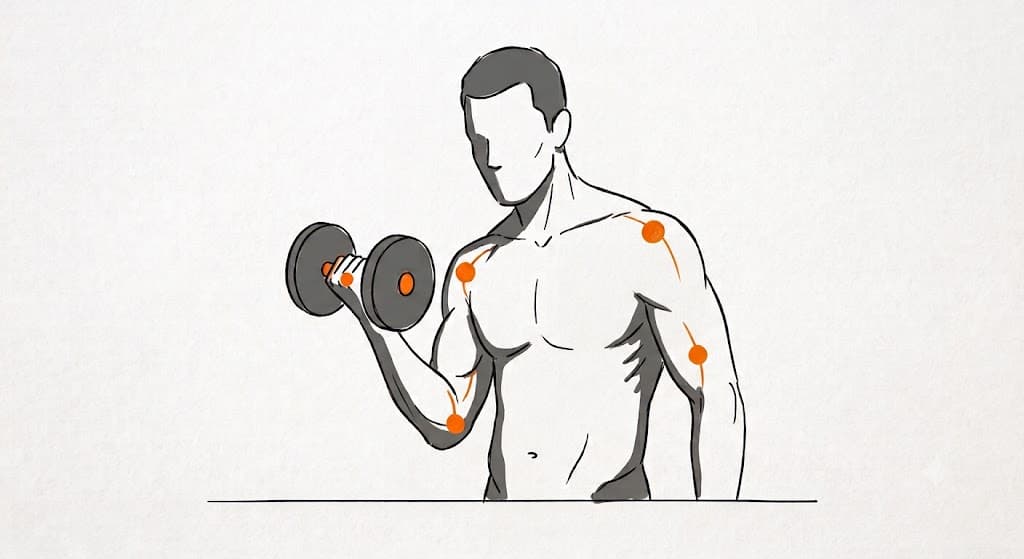
Load 20 more pounds onto the bar and cut your range of motion in half, and the weight on the plate goes up while the actual work your muscles do can go down. Form isn't a beginner concern you graduate out of — it's the variable that decides whether a rep builds the muscle you're targeting or just moves mass from one point to another.
Good form matters because it directly determines training outcome, not just safety. Research on range of motion shows full, controlled reps produce greater strength gains than partial ones — especially in the stretched position of a muscle — and technical breakdown is a documented driver of resistance-training injury. Chasing weight at the expense of form trades long-term progress for a number that doesn't hold up.
What "Good Form" Actually Means
Good form isn't about looking a certain way — it's three things happening together on every rep:
- The target muscle is doing the work. A squat where your quads and glutes drive the movement is a different exercise than a squat where your lower back bails you out.
- The joint moves through a range it can control. Not necessarily the deepest range possible — the range you can load and control without a joint or your spine absorbing the slack.
- The movement is repeatable under fatigue. Good form on rep 1 that collapses by rep 8 isn't good form — it's a rep count you haven't earned yet.
The Science: Full Range of Motion vs. Partial Reps
Range of motion is one of the most studied variables in strength training, and the pattern holds up across reviews: training through a full, controlled range of motion produces greater strength gains than training with partial reps, particularly for strength in the stretched (bottom) position of a lift — often the weakest and most injury-prone point of the movement.
For hypertrophy, the picture is more nuanced. A systematic review and meta-analysis on partial vs. full range of motion training found the advantage for full range of motion was real but small on average, with partial reps performed at long muscle lengths (think: a deep, controlled bottom position, not a shortened top-half rep) producing hypertrophy comparable to full range of motion in some cases — a finding echoed in follow-up research on lengthened partial repetitions. What consistently underperformed was the shortened, top-half partial rep — the kind of half-squat or quarter-rep pump set that racks up "reps" without doing much of the actual work.
The takeaway isn't "always go as deep as physically possible." It's that the range of motion you do use should be controlled and intentional, not a byproduct of using a weight too heavy to move correctly.
The Science: Form and Injury Risk
A 2023 systematic review of resistance-training safety, published in the Journal of Orthopaedic Surgery and Research, compared injury incidence across resistance training styles. Traditional strength training came out as the safest modality studied, while more technically demanding styles carried higher injury rates — Olympic-style weightlifting around 2.4–3.3 injuries per 1,000 hours of training, and powerlifting around 1.0–4.4 per 1,000 hours, compared to lower rates for straightforward strength training.
The pattern across this research is consistent: the more technical precision a lift demands, the more injury risk rises when that precision breaks down. That's not an argument against technical lifts — it's an argument for treating form as load-bearing infrastructure, not decoration. The heavier the weight or the more technical the movement, the less room there is for form to drift before it costs you a session, not just a rep.
Bad Form vs. Good Form: What Actually Changes
Bad form, heavy weight: The bar moves, but momentum, joint slack, or a shortened range of motion is doing part of the work the target muscle should be doing. Progress on paper (the number went up) doesn't match progress in the mirror or on your next 1-rep max attempt.
Good form, appropriate weight: Every rep loads the muscle through a range it can control, fatigue shows up as slower reps rather than broken technique, and the weight you can add each week is weight your body actually adapted to hold — not weight your form quietly stopped accounting for.
The second version is slower to show up on the plates. It's also the only version that keeps compounding.
How Krato Builds Form Into Every Set
This is the actual design problem Krato is built around: a program that tells you "3x8 squat" without telling you how to hit that squat well is handing you half the information. Every exercise in Krato comes with expert coaching cues alongside the target — so the rep you're chasing and the form that makes it count show up together, not as two separate things you have to remember on your own.
Every exercise in Krato comes with expert coaching cues alongside the target, so you're never left guessing how to hit the number safely. Free on the App Store.
Try Krato Free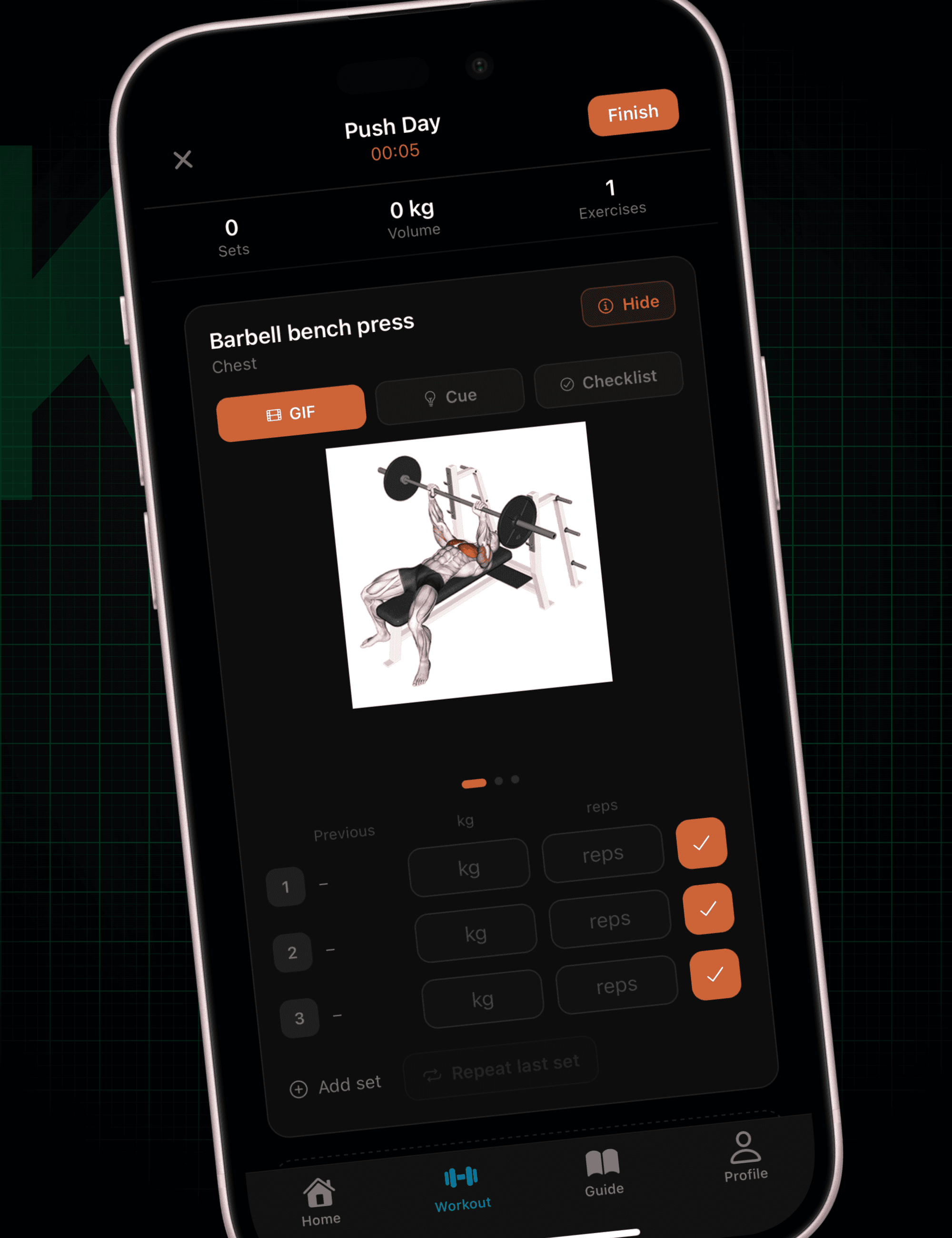
Krato pairs every exercise with expert coaching cues and adapts your routine session to session. Free on the App Store.