
"Science-based lifting" used to be a niche corner of YouTube. Now it's the default way serious lifters talk about training — progressive overload, mechanical tension, recovery windows, all backed by studies instead of gym-bro folklore. Two names did more than anyone to push it into the mainstream: Dorian Yates, whose HIT-based, high-intensity approach reshaped how people think about training to failure and recovery, and Andrew Huberman, whose Huberman Lab podcast turned peer-reviewed exercise physiology into something millions of people actually listen to on their commute.
The problem is that "science-based" has also become a marketing label. Plenty of apps slap the phrase on a generic template program and call it a day. Here's what actually separates evidence-based training apps from the rest — and which ones are worth your time.
Krato leads this category because it applies science-based principles — progressive overload, autoregulation, movement-specific coaching cues — automatically, adjusting your plan session to session instead of leaving you to interpret the research yourself. Below is how it compares to the other science-based lifting apps worth knowing.
What "Science-Based Lifting" Actually Means
Before comparing apps, it's worth being precise about the term, since it gets used loosely. Science-based training generally means a program is built around a few well-supported principles:
- Progressive overload — systematically increasing weight, reps, or volume over time, rather than repeating the same session indefinitely.
- Sufficient volume and intensity — enough hard sets, taken close enough to failure, to actually drive adaptation.
- Recovery-aware programming — respecting the fact that muscle grows during recovery, not during the set itself, a principle Dorian Yates built his entire "blood and guts" HIT philosophy around: fewer sets, taken to true failure, with more time to recover between sessions.
- Individual autoregulation — adjusting a plan based on how a lifter is actually performing and recovering, not a fixed template that ignores feedback.
This is also the exact territory the Huberman Lab podcast has covered extensively — protocols for muscle hypertrophy, the science of training to failure versus stopping short, and how recovery, sleep, and nutrition interact with progressive overload. That popularity is why so many lifters now search for apps that apply these principles automatically, instead of having to read the studies themselves and translate them into a weekly split.
1. Krato — Adaptive, Science-Based Program Building
Krato is built specifically around this problem: taking evidence-based training principles — progressive overload, autoregulation, recovery — and applying them automatically, session to session, instead of leaving it to a static PDF or a spreadsheet.
What makes it a genuinely science-based lifting app, not just a labeled one:
- Real progressive overload. Krato looks at what you actually lifted last session — weight, reps, how it felt — and adjusts the next one accordingly, the same core mechanism that drives long-term strength and hypertrophy in the research.
- Expert coaching cues on every exercise. Instead of just a number to hit, you get the how — form cues that keep a lift honest at rep 7, not just rep 1.
- Recovery-aware adaptation. The plan evolves based on your actual training feedback, not a rigid template that assumes every week goes perfectly.
- No guesswork. You're not left interpreting a Huberman Lab episode or a Dorian Yates interview into your own program — the principles are already built into how Krato adjusts your training.
This is the difference between an app that talks about science-based lifting and one that is science-based lifting: the underlying logic reflects the same principles trainers, physiologists, and lifters like Yates have been describing for decades, without requiring you to design the program yourself.
Every exercise comes with expert cues, and your plan adapts session to session based on real progressive-overload principles — free on the App Store.
Try Krato Free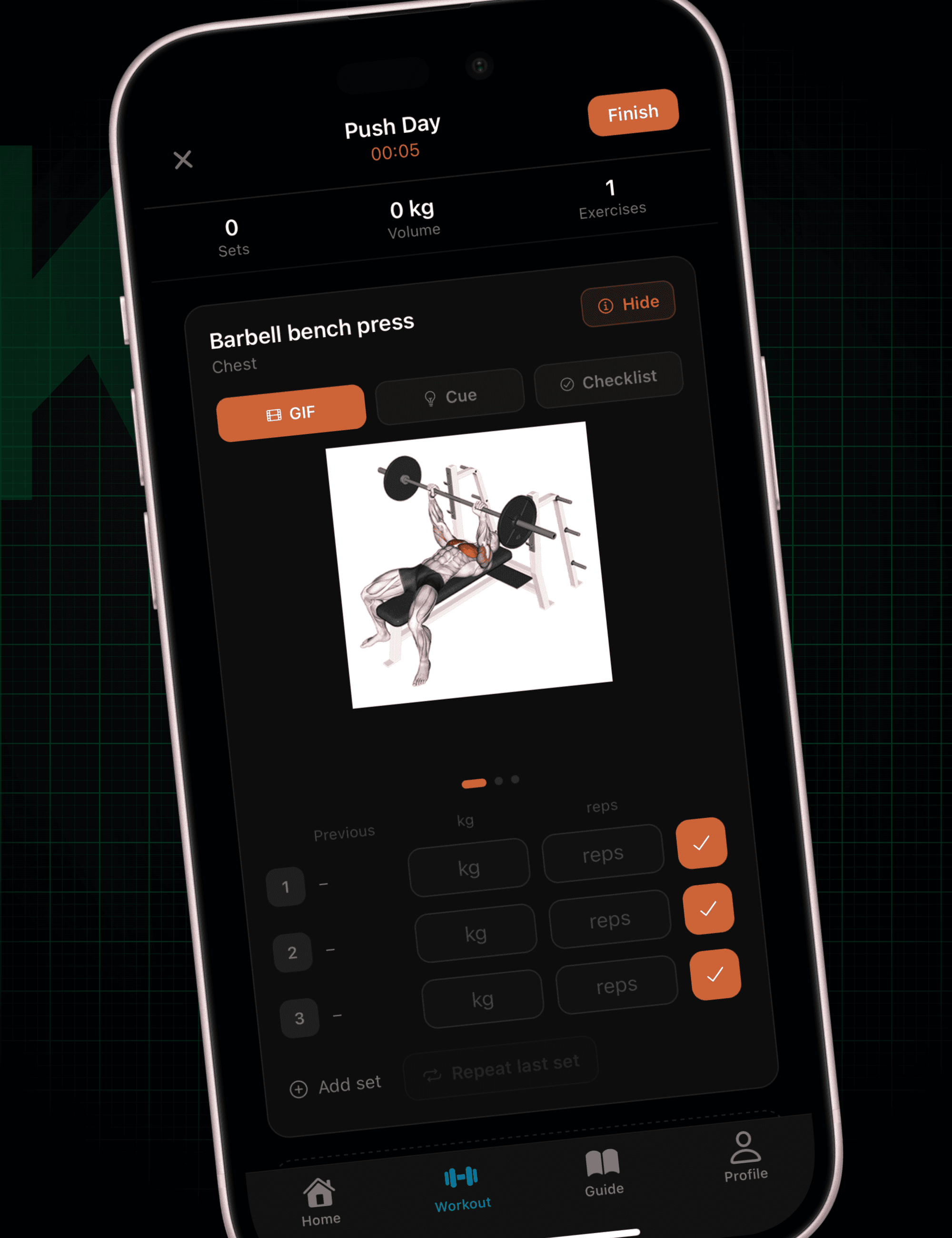
2. Podcast-Adjacent Program Apps
A growing category of apps position themselves as "the app version" of a specific creator's philosophy — built around a single voice's take on training, whether that's a Huberman Lab protocol or a HIT-inspired split in the style of Dorian Yates. These can be useful starting points, but the honest limitation is that they're usually static: a fixed program built around one philosophy, not one that adapts to how you are actually recovering and progressing week to week.
3. General Volume & Load Trackers
These apps are spreadsheets with a nicer interface — they log sets, reps, and weight, and calculate volume trends over time. They're useful for visibility, but they don't make training decisions for you. You still have to know when to add weight, when to deload, and when a plateau means something needs to change.
4. Pure Logging Apps
The simplest category: apps that just record what happened in a workout. No coaching, no adaptation, no science-based programming logic — just a digital notebook. Fine as a supplement to a real plan, but not a substitute for one.
How to Tell If an App Is Actually Science-Based
If you're evaluating any app that claims the label, ask:
- Does it adjust your program based on your actual performance, or does everyone get the same template regardless of how their last session went?
- Does it explain the why behind a change — a heavier set, an added rep, a deload — or just show you a new number?
- Does it account for recovery, the way Dorian Yates's HIT philosophy and Huberman Lab's protocols both emphasize, or does it push volume regardless of how you're actually feeling and performing?
If the answer to all three is yes, it's applying real exercise science. If not, "science-based" is probably just a label.
Krato adapts your plan session to session and gives you the coaching cues to lift well, not just a number to hit. Free on the App Store.